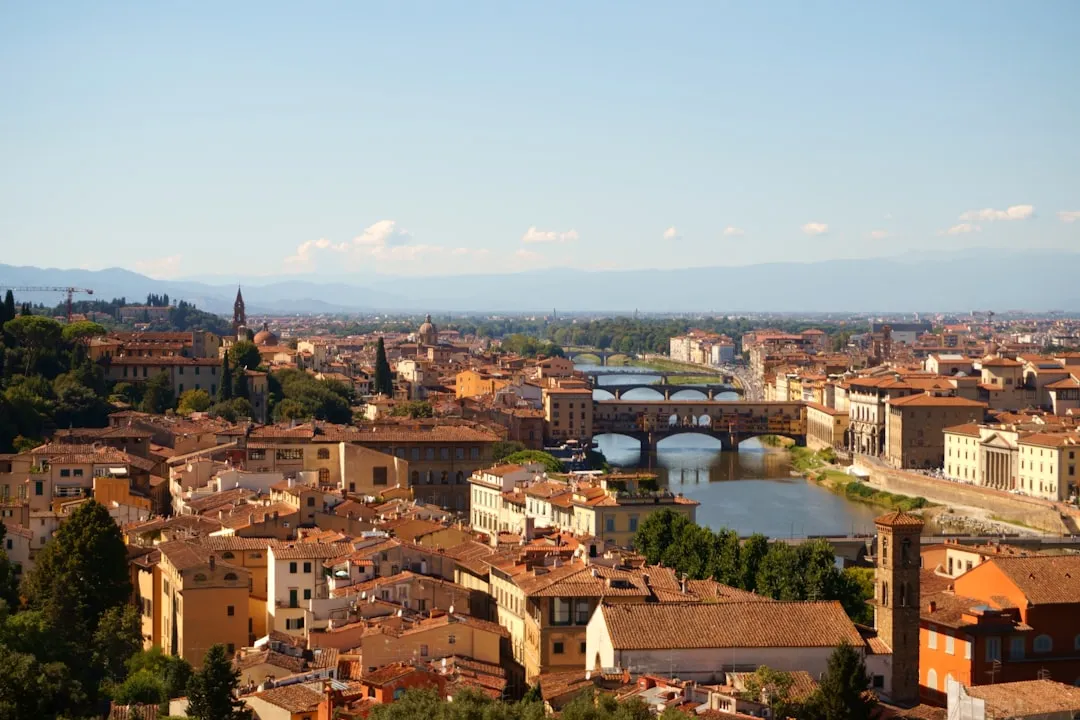
A little while ago I watched a five-second clip - an ancient, weathered column. That was all it took to identify the exact place where those images had been filmed. A moment later they widened the shot, and I recognised the precise spot. It was a city. My city.
Childhood memories stay imprinted in the mind far, far longer than those accumulated in adulthood.
In the square full of columns where that footage was shot, I used to go often with my grandmother, as a child, to the fruit and vegetable market - with that strong, distinctive scent of a herb market. As a teenager, I would sit on those low walls and lean against those columns with my friends, talking about the things teenagers talk about, dreaming and living. Those columns, like other corners of that city, were my world. And the pizzeria nearby, which tempted us every afternoon with the fragrance of freshly baked focaccia.
Ancient cities have a particular quality: they remain unchanged in space and time, allowing memories to reinforce their own persistence. There was a phase of my life when that city was perfect. I knew almost all my peers, at least by sight. All I had to do was step out at half past six in the evening, walk into the centre, and run into someone to exchange a few words with or take a stroll. No appointments needed - we all knew that if we were free, we only had to go into the centre and we would find each other, and then make plans from there. Mobile phones either didn't exist or were still expensive and primitive, and yet social life existed all the same.
When the time came to go to university, many kilometres away, it felt like a trauma. I knew something would change - who knows, perhaps forever - and I decided to cling to my old life. Every weekend I took the train back, even if only for forty-eight hours, to keep living my life - that life - which I had earned with so much effort and which was slipping through my fingers. Some of my friends had stayed in the area; others hadn't moved far, choosing universities nearby or going straight into work.
A few months in, on the train, I was so excited about a dinner organised at one of their houses that I had jotted down notes about the countless things that had happened to me in Bologna during that period - things I couldn't wait to share. I arrived right on time, busied myself helping out - nothing was supposed to change - until we sat down at the table. The conversation drifted across the usual topics, the usual people, and when I took the floor to talk about my experiences, the conversation dropped shortly after. I didn't think much of it - conversations have a life of their own, take unexpected turns. The second time, when directly asked, I started again, and again the conversation dropped.
I was stunned: the lapse, I realised, was not accidental. So I fell quiet, participating half-heartedly in the usual talk about the usual people, the usual places, the usual things. At the end of dinner, a couple of friends who had also moved away - to Milan, for their studies - came over and, pulling me aside, said something that stopped me cold: "They're not interested in what we're doing outside of here. Those who stayed have no interest in what happens to us out there. Some out of a kind of resentment, others simply out of genuine indifference. Their whole world is here - and what we do beyond it is, for them, completely irrelevant."
I realised they were absolutely right. Even when we had greeted each other at the start of dinner, after weeks apart, no one had asked: "So, how's your new life going?" They had continued seeing each other often, but I had stayed away for a while, held back by exams. This seemed to produce no variation on the theme whatsoever. I ran a social experiment: I took the floor again and shared a piece of local gossip. In that moment I had their complete attention - everyone, and I mean everyone, hung on my every word until the very last detail. I went home incredulous. What I had feared had probably come to pass - my life had changed, yes, but not so dramatically. But for them, my life was now different, outside their circle of interest, and in that moment foreign to them, unless it aligned entirely with their expectations. My determination not to cut the umbilical cord only worked if my social life revolved around events that had happened between Friday and Sunday. If something strange had happened to me on a Wednesday in Bologna - indifference. If I had a funny story - silence. If instead I had mentioned that a former classmate had broken up with his girlfriend - total attention. The whole train journey, then, served only to feed in me the illusion of a continuity that was already compromised. I concluded the effort was one-sided, and gradually, I let go.
But I didn't give up on reclaiming what was mine. As soon as I graduated - though I was already teaching and working - I set about finding a way to get closer again. To return to my city. And this desire was so strong that it didn't allow me, at least back then, to consider Bologna as a permanent home in any way. I hadn't even bothered to adapt, to make too many friends - "I'll be going back to my city soon."
Having kept good relations with everyone, I immediately started sending out CVs. Letting people know - friends, acquaintances, contacts - that I was ready to come back, ready to start from the bottom if needed, just to return.
Many pretended not to hear. Others called me in for interviews - and when they understood what I wanted and what I could do, they dismissed me with a flat "you're overqualified for what we're looking for." I was told my skills exceeded those of the owner, and that was completely inconceivable. I tried to enter a public competition - nothing doing: the role required a diploma in IT subjects. A degree, though a higher qualification, would not be valid. And a strong knowledge of French was required - though no one could explain why. I understood. Later, I discovered the competition had been tailored specifically for someone who was always going to get the role. My interest had only "complicated things." Undeterred, I pressed on - until I reached the encouraging offer: "You work for me for three years for free, I sell the service. If I make enough, I'll pay you. Otherwise we part ways - you're young, you have time." When I asked for more details about what "enough" meant, the person grew irritated and ended the conversation quickly, calling me a "presumptuous kid."
Meanwhile, in Bologna I had a dream salary and was doing work I loved. In a city that was not "mine", where I knew no one, but where people actually wanted to use my skills. Since part of my work involved training funded by European grants, I decided to try bringing that kind of training to my city. They already had IT courses - the classic "How to use Windows to write in Word" kind. I would simply bring what I was doing in Bologna, manage everything myself, adding value without taking anything away from anyone. No one listened. Determined, I spoke to an influential person and put forward my proposal. He told me, in all honesty, that this type of course had "always" been run by an elderly engineer, now in his eighties, and that there was no interest in expanding these projects into more modern forms. "If you want, I can look into it and try to speak to a politician, but I can't promise anything. Even if it's paid for by European funds."
That afternoon I drove for 30 kms and sat by my sea. It was moving at just the right pace - that steady, rhythmic sound, the smell of the shoreline and the fine mist of salt that clings to your lips, so that when you run your tongue across them you can taste it too. And I understood, beyond any doubt, that my life would not be in that city.
Almost all of my friends - the ones who didn't have their own businesses in the city - were now scattered across the world. The results had been the same for all of us. The ancient walls were still there, but "my people" were gone. My city no longer existed. Perhaps it had never quite existed at all. Or perhaps simply the fourth dimension - time - had erased what had made it so desirable to me. And I stopped trying, with the bitterness of someone who understands that the dream was always a pale illusion.
I don't go back to my city very often. Sometimes years pass between one visit and the next, because the feeling is divided: on one side, the sweet pleasure of memories. On the other, the sharp sting of rejection. Not of me, but of improvement, of change. The city continues, even today, to live in a self-referential closure, where many of its more ambitious children have found their paths far away, while those who remain indifferent to what happens beyond its walls keep speaking to the instincts of those who stayed. The population is in freefall.
When I speak today with someone who remained, that person still carries that sense of quiet resentment - as if the fault for all of this were mine, and the fault of everyone who left. But I don't hold it against them. They live inside a bubble made of former glory - family businesses, public sector jobs, privileged positions. They have never seen or experienced what it means to want to be, in some way, part of something important. So I have stopped defending myself too, because my city - if it ever existed in the form I knew it - has been gone for over twenty-five years. The market hasn't been held in that square for a long time now. The pizzeria on the corner has closed.
Now it is their city.
Beautiful, to visit. But not mine.